The pricing formula
- Estimate hours for the package on a mid-size car in average condition. Time yourself on real jobs; it's the number most detailers underestimate.
- Multiply by your target hourly rate (see below).
- Add product cost per job: chemicals, pads and towels (amortized), water if you supply it.
- Add travel for mobile work, e.g. a per-mile fee beyond a free radius.
- Adjust for size and condition with multipliers or fixed surcharges.
- Round to clean menu prices and check against the market.
| Worked example | Value |
|---|---|
| Full detail, mid-size SUV, 4.0 hrs × $55/hr | $220 |
| Product cost | $18 |
| Travel (14 mi, first 10 free, $1.50/mi) | $6 |
| Price | $244 → menu price $245 |
All dollar figures on this page are examples to show the math, not recommended prices. Use your own costs and market.
Setting your target hourly rate
Your hourly rate has to cover more than your time on the car: drive time, quoting, admin, insurance, equipment wear, vehicle costs, marketing and taxes. A simple way to work it out:
target hourly = (monthly income goal + monthly business costs) ÷ billable hours per month
Example: ($4,000 + $1,000) ÷ 90 billable hours ≈ $56/hr. If you only bill 60 hours, you need about $83/hr for the same result. That's why tracking real hours matters.
Vehicle size and condition
| Size tier | Typical vehicles | Example multiplier |
|---|---|---|
| Small | Coupes, compact sedans | 0.9× |
| Mid-size | Sedans, small SUVs | 1.0× (base) |
| Large | 3-row SUVs, half-ton trucks | 1.2× |
| Extra large | Vans, lifted or heavy-duty trucks | 1.4× |
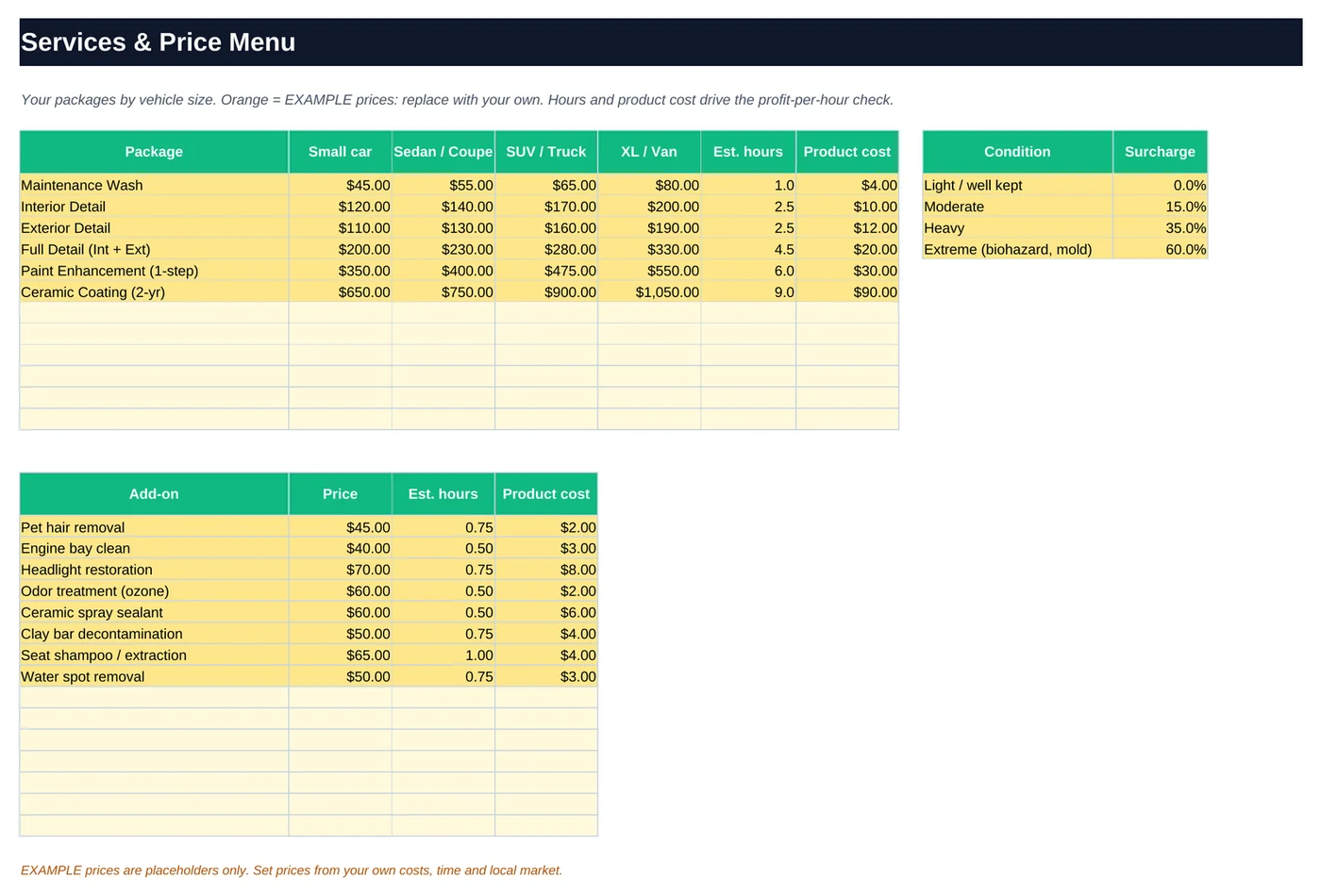
Condition surcharges (for example +15% moderate, +30% heavy soil) protect you from jobs that take twice as long. Price excessive pet hair, sand, mold or biohazard as separate add-ons with photos required before quoting.
Price add-ons from time and product
Each add-on gets its own time and product cost: add-on price = minutes ÷ 60 × hourly rate + product. A 30-minute pet hair removal at $55/hr with $3 of product is about $31. Many detailers round up for unpleasant work.
Check against your local market
- Look up 3–5 local competitors' published menus and reviews.
- If you're far below the market, raise prices. If you're far above it, make sure your reviews, photos and results back that up.
- Recalculate whenever product costs or your hours change.
Common pricing mistakes
- Pricing only by what competitors charge.
- Ignoring drive time on mobile jobs.
- One price for every vehicle size.
- No condition surcharge, then losing money on the worst cars.
- Never checking real profit per hour after the job.
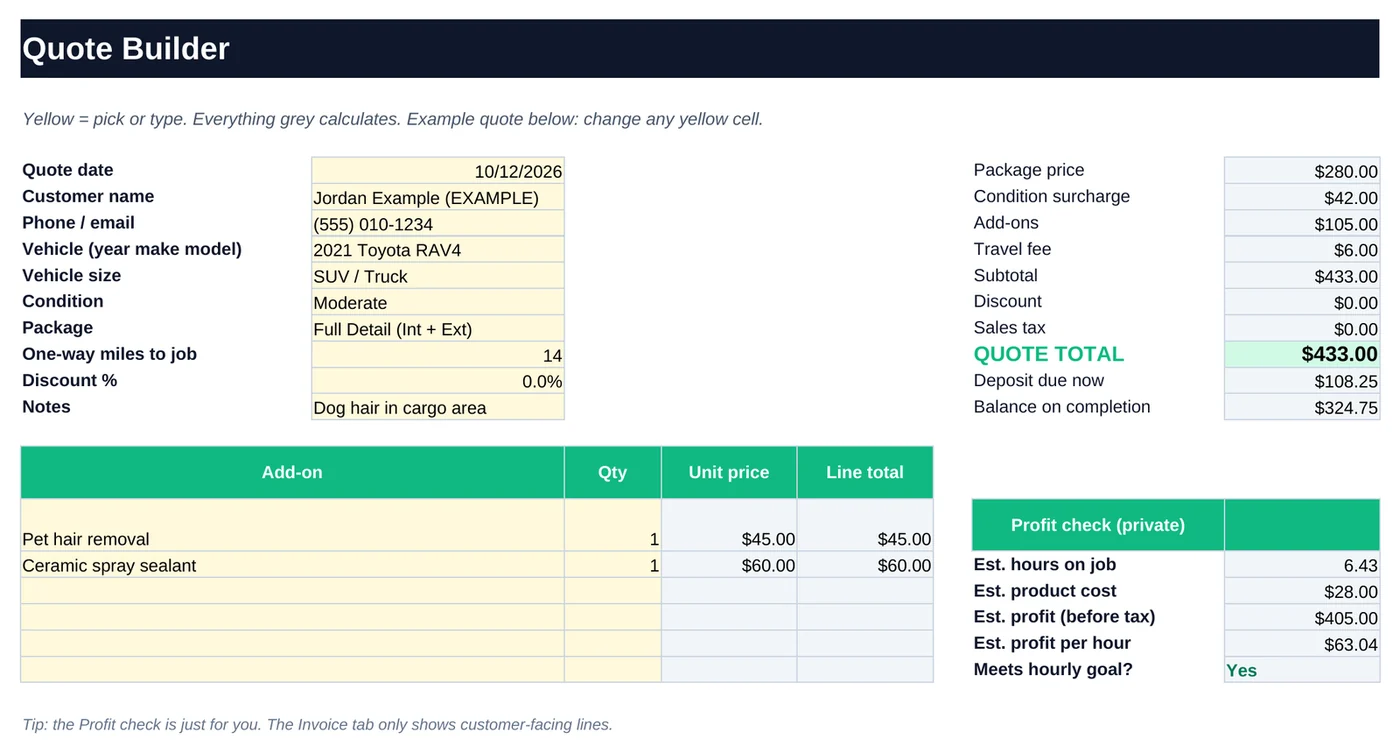
DetailTab's Quote Builder does this math for you and shows a private profit-per-hour check on every quote.
Frequently asked questions
How do I calculate what to charge for detailing?
Estimate the job's hours, multiply by your target hourly rate, add product cost and any travel fee, and adjust for vehicle size and condition. Then compare with local competitors.
What hourly rate should a detailer charge?
Enough to cover your income goal plus business costs divided by realistic billable hours. It depends on your costs, location and skill, so calculate it rather than copying a number.
Should I charge more for SUVs and trucks?
Yes. Larger vehicles take more time and product. Use size tiers or multipliers so your hourly profit stays consistent.
How should I price pet hair or very dirty cars?
Use condition surcharges or separate add-ons priced from extra time and product, and ask for photos before quoting.
Stop guessing. Quote in under a minute.
The DetailTab Pricing & Quote Kit: Quote Builder, Invoice, Price Menu, Job Log, Customers and Monthly Summary for Excel and Google Sheets. $19 one-time, no subscription.